DIY vs Professional Water Damage Repair: When a Towel Won't Cut It
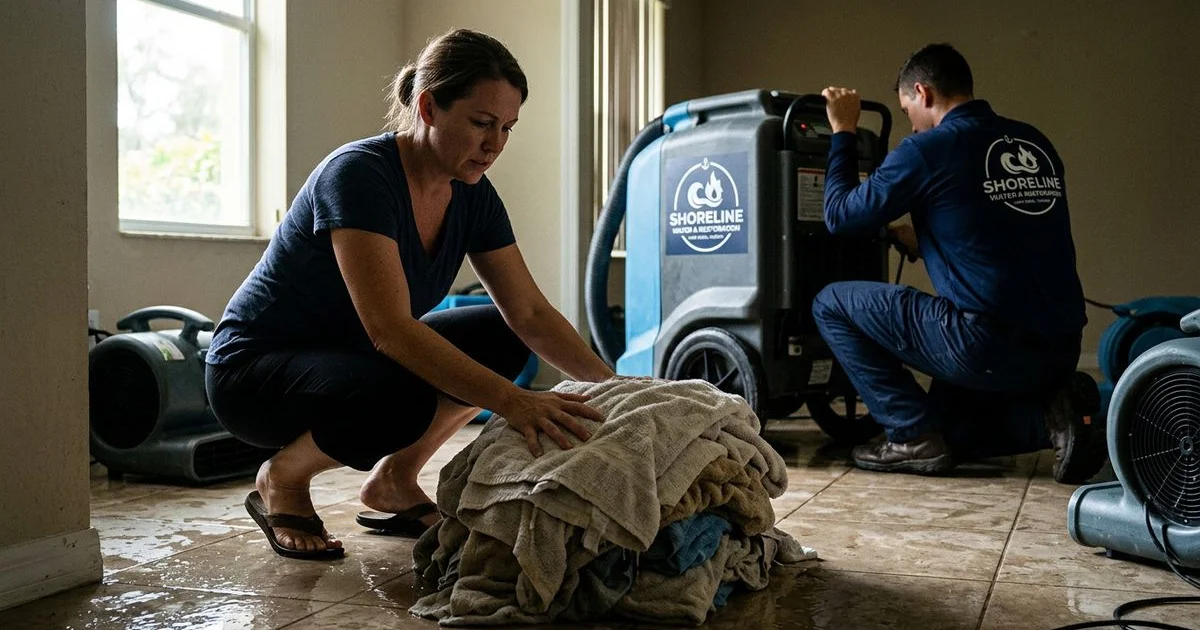
We see the same scenario play out every week across Cape Coral properties, where an unexpected leak strikes and the immediate instinct is to grab a shop vacuum. This reaction makes perfect sense for a minor spill. Rapid response prevents simple accidents from becoming permanent stains.
Our restoration teams understand the urge to clean up quickly and move on.
Most water events require much more than a simple surface wipe. The risk of long-term structural decay increases every hour water sits.
We know that DIY cleanup addresses visible water while leaving behind hidden moisture. That hidden moisture leads to mold growth, structural deterioration, and major repair costs. An informed approach saves property owners thousands of dollars.
Our guide breaks down the data so you can make a safe choice. The choice between DIY vs Professional Water Damage Repair: When a Towel Won the day or failed completely depends on a few strict rules.
When DIY Cleanup Is Appropriate
Our guidelines for DIY work align with the Institute of Inspection, Cleaning and Restoration Certification, known as the IICRC. The IICRC S500 standard classifies clean, sanitary leaks as Category 1 water losses. You can likely handle the cleanup yourself if all of the following conditions are met:
- The water source is clean, coming from a supply line, faucet, or ice maker.
- The amount is small, totaling less than a few gallons and confined to a small area.
- You caught it immediately, meaning the water has been standing for less than one hour.
- No carpet or padding is wet, and only hard surfaces are affected.
- No drywall is wet, so water has not wicked up walls or soaked into wall cavities.
- No water has entered cabinets, closets, or enclosed spaces.
We often tell clients that true DIY cleanups look like knocking a glass of water off the kitchen counter and mopping it up within five minutes. Another example involves a small drip from under the bathroom sink that wets a tiny area of tile. You dry it with towels the same day.
Our experts agree with the Federal Emergency Management Agency on prevention timelines. FEMA states that mold growth is highly unlikely if you dry wet, Category 1 materials completely within 24 to 48 hours.
When to Call Professionals
Time and Material Saturation
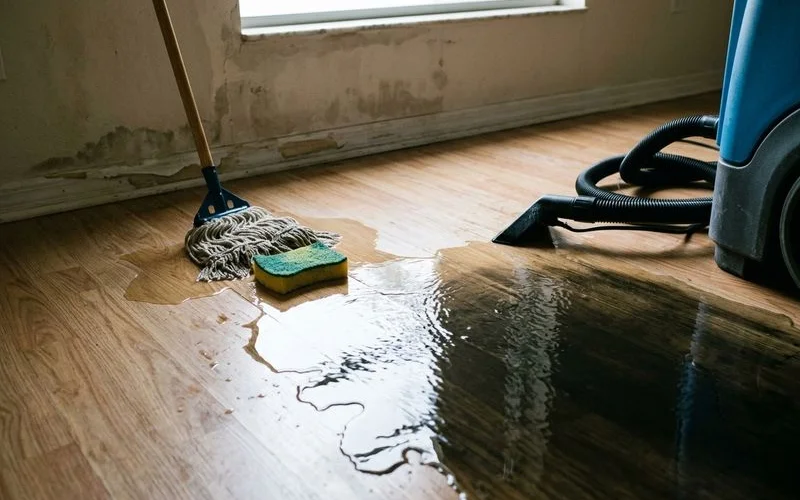
We always warn homeowners that water sitting longer than an hour changes the situation completely. Even clean water begins causing secondary damage after 60 minutes. Drywall starts absorbing moisture and swelling.
Our specialized equipment is necessary because wood flooring starts warping and carpet padding becomes saturated. Carpet padding holds 5 to 10 times its weight in water. Even if the carpet surface feels only damp, the padding underneath is likely saturated.
We know that padding remaining wet for more than 24 hours in Cape Coral’s humidity will begin growing mold. Professional extraction using weighted tools is the only way to remove water from padding in place. Drywall wicks moisture upward at approximately 1 inch per hour.
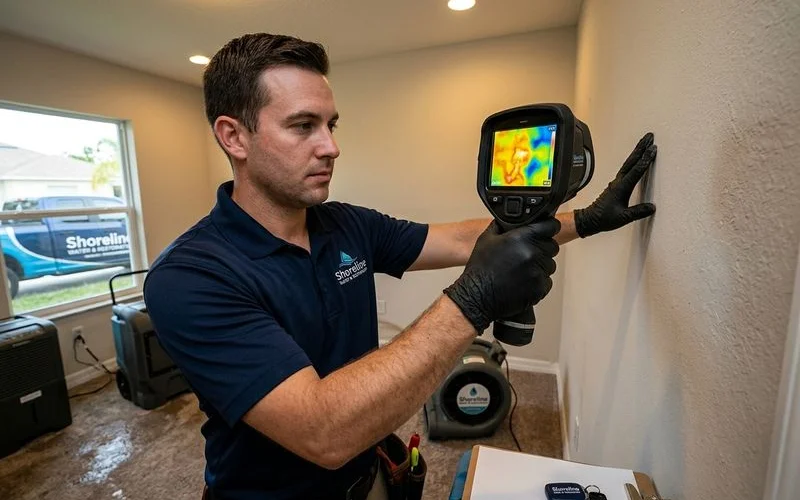
Our technicians find that by the time you see a visible watermark on the wall, moisture has already migrated 12 to 18 inches higher. Professional moisture meters and infrared cameras are needed to determine the true extent of moisture migration inside wall cavities.
Contamination and Spread
We strictly adhere to safety protocols for contaminated sources. Any water from a toilet overflow without visible waste, dishwasher discharge, washing machine drain, or sump pump is classified as Category 2. This gray water requires antimicrobial treatment to prevent sickness.
Our biohazard teams must handle water from a sewage backup or flooding containing fecal matter. This is classified as Category 3 black water and absolutely requires professional decontamination. Multiple rooms require a different approach entirely.
We calculate the exact placement of dehumidifiers and air movers based on the volume of the affected space. Professional drying relies on ambient humidity conditions and the types of materials involved.
Visible Mold and Secondary Damage
We urge property owners to step back if they see or smell mold. The Environmental Protection Agency warns that mold begins colonizing hidden damp surfaces within 24 to 48 hours. If mold is already growing, the moisture problem has been present long enough for colonization.
Our containment barriers are critical because disturbing mold spreads spores throughout your home. Professional remediation with HEPA filtration is required to keep the air safe.
The Hidden Damage Problem
We frequently encounter situations where the biggest risk of DIY water damage cleanup is the damage you cannot see. Consumer equipment removes surface water effectively. Household tools cannot detect or remove moisture trapped deep within building structures.
- Moisture traveling inside wall cavities behind drywall.
- Water saturating insulation inside walls and attics.
- Puddles collecting on top of concrete slabs beneath floating floors.
- Liquid wicking into wood subflooring beneath tile or hardwood.
- Humidity entering HVAC ductwork through return air vents near floor level.
Our daily inspections prove that this hidden moisture is where mold growth begins. In Cape Coral’s subtropical climate with average humidity levels above 70 percent, the risk multiplies rapidly. Homeowners who complete a DIY cleanup often discover mold growth weeks or months later.
Our repair teams then have to open walls, remove flooring, and tear out cabinets. This delayed remediation costs far more than the original water damage restoration would have.
The Cost Comparison
We hear from many homeowners who avoid calling professionals because they assume it will be expensive. The reality is quite different when you look at national data. According to 2026 data from Angi, the average cost for professional residential water damage restoration is $3,867.
Our experience aligns with the Insurance Information Institute, which reports the average water damage claim cost is around $11,000 when secondary damage occurs. Here is the reality of the financial breakdown.
| Expense Category | DIY Cleanup Missing Hidden Moisture | Professional Restoration From Day One |
|---|---|---|
| Initial Extraction | $0 to $200 for towels and shop vacuum rental | $1,500 to $4,000 for structural drying |
| Mold Remediation | $3,000 to $10,000+ required 3-6 months later | $0 (Prevented by rapid drying) |
| Material Replacement | $2,000 to $8,000 for drywall and flooring | $0 (Materials saved) |
| Total Out-of-Pocket | $5,000 to $18,000+ | $500 to $2,500 (Insurance deductible only) |
We remind clients that professional restoration on day one is almost always less expensive than DIY cleanup followed by mold remediation. A common mistake involves trying to clean the damage before calling the insurance adjuster. Insurance companies can deny claims for a failure to mitigate if DIY efforts destroy evidence of the original leak.
What Professionals Bring That You Do Not Have
We invest heavily in commercial equipment because standard household tools fail under pressure. A typical wet/dry shop vacuum pulls about 100 to 150 cubic feet per minute of air. That is not enough suction to pull water through a dense carpet pad.
- Truck-mounted extraction systems that remove water 50 times faster than a shop vacuum, pulling over 300 to 400 cubic feet per minute.
- Infrared thermal imaging cameras that reveal hidden moisture inside walls, ceilings, and floors.
- Professional moisture meters that measure moisture content in wood, drywall, and concrete.
- Commercial dehumidifiers that pull 30 or more gallons of water per day from the air, compared to household units pulling only 3 to 5 gallons.
- High-velocity air movers that create targeted airflow across wet structural surfaces.
- Antimicrobial treatments that stop bacteria during the drying period.
Our administrative staff also brings vital insurance expertise to the table. Proper documentation using Xactimate estimating software is the industry standard. Adjusters use this exact software, meaning an itemized Xactimate report drastically speeds up your claim approval.
The Bottom Line
We want you to feel confident making the right call for your property. If you can see the water, contain it with a towel, and dry the area completely within an hour, professional help is likely unnecessary. This is the exact scenario for DIY vs Professional Water Damage Repair: When a Towel Won the battle cleanly.
Our emergency crews are ready if the water has been standing, spread beyond a small area, touched carpet, or came from a contaminated source. The cost difference between early professional intervention and delayed remediation is measured in thousands of dollars.
Call (239) 323-1779 for a no-cost assessment. We will tell you honestly if you need professional help or if you can handle it yourself.

Paul Breehne
Regional Franchise Operator
Paul Breehne is a Regional Franchise Operator for Shoreline Water & Restoration in Southwest Florida, bringing over a decade of hands-on restoration experience to the Cape Coral market.
Need Emergency Restoration?
Shoreline Water & Restoration provides 60-minute emergency response in Cape Coral.
Call (239) 323-1779