Mold Testing vs Mold Remediation: What's the Difference and Do You Need Both?
When Cape Coral homeowners suspect mold in their property, they often ask “do I need mold testing or mold remediation?” The answer depends on the situation, but understanding the difference between these two distinct services — and when you need one, the other, or both — helps you make informed decisions and avoid unnecessary costs.
What Is Mold Testing?
Mold testing (also called mold inspection or mold assessment) is the process of determining whether mold is present, what type it is, and how concentrated it is in your indoor air and on surfaces. It is a diagnostic service, similar to getting a medical test — it tells you what the problem is, but it does not fix it.
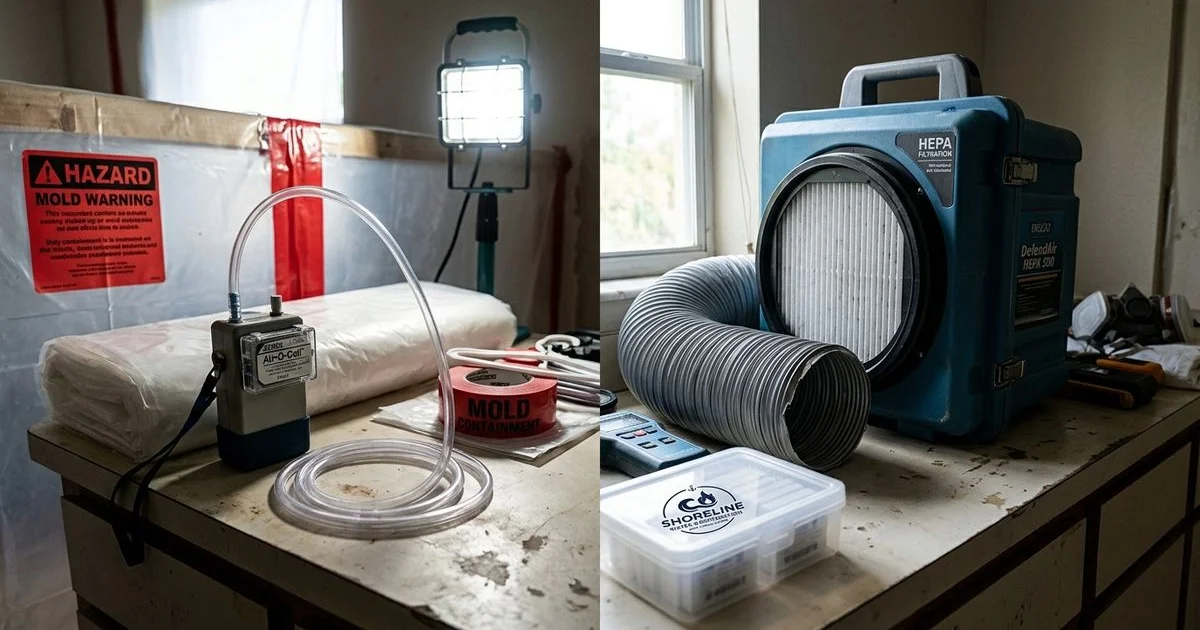
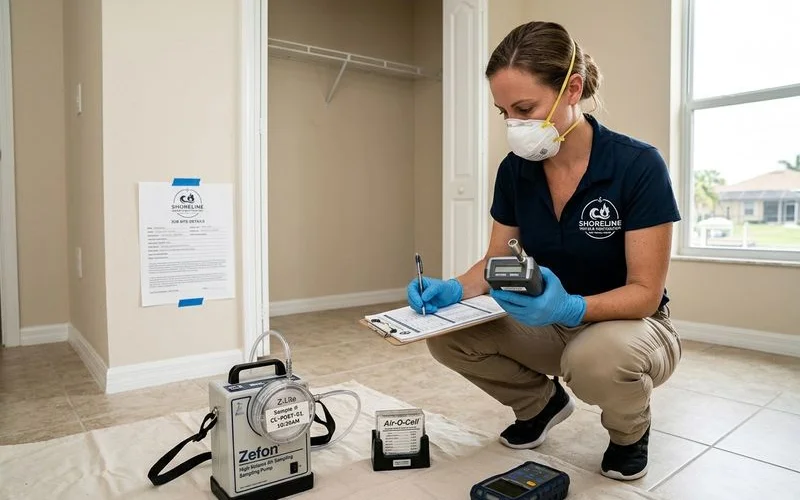
Air sampling is the most common testing method. An air sampling pump draws a measured volume of air through a cassette that captures airborne mold spores. The cassette is sent to an accredited laboratory for analysis, which identifies the types and concentrations of mold spores present. Indoor samples are compared to outdoor baseline samples to determine whether indoor mold levels are elevated.
Surface sampling involves collecting samples directly from suspected mold growth using tape lifts, swabs, or bulk material samples. Lab analysis identifies the mold species and can determine whether growth is active.
Moisture assessment is a critical companion to mold testing. Professional moisture meters and thermal imaging cameras identify moisture sources that are feeding mold growth — without correcting the moisture source, remediation will not be permanent.
In Florida, mold assessors must hold a state license (MRSA — Mold-Related Services Assessor) issued by the Department of Business and Professional Regulation. This is separate from the license required for remediation.
What Is Mold Remediation?
Mold remediation is the physical process of removing mold from your property and restoring safe conditions. It is a construction and cleaning service that involves containment, removal, decontamination, and verification.
Key remediation activities include:
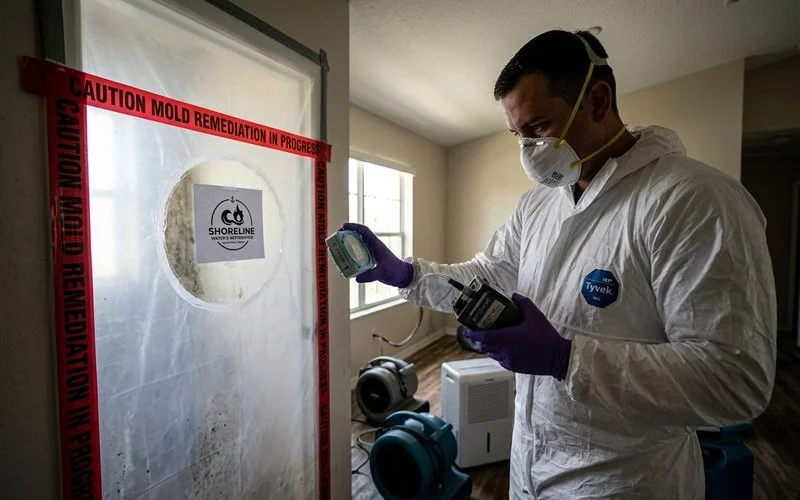
- Containment — sealing off the affected area with polyethylene barriers and negative air pressure to prevent spore migration
- HEPA air filtration — running industrial air scrubbers that capture 99.97% of particles down to 0.3 microns
- Material removal — demolishing and disposing of mold-infested materials (drywall, insulation, carpet, wood) that cannot be salvaged
- Surface treatment — cleaning remaining structural surfaces with antimicrobial and antifungal solutions
- HEPA vacuuming — removing residual spores from all surfaces
- Moisture correction — addressing the source of moisture that caused the mold
In Florida, mold remediators must hold a state license (MRSR — Mold-Related Services Remediator). By law, the same company cannot perform both the assessment and the remediation — this separation ensures independent verification that remediation was successful.
Do You Need Testing, Remediation, or Both?
You likely need testing only if:
- You suspect mold but cannot see it (musty odor, health symptoms, recent water damage)
- You want to confirm whether visible discoloration is actually mold
- You are buying or selling a property and want a clear report
- You are a landlord responding to a tenant complaint
You likely need remediation only if:
- Mold is clearly visible and the affected area is larger than 10 square feet
- A previous test already confirmed elevated mold levels
- You know the moisture source and the mold species is not in question
You need both testing and remediation when:
- Mold is visible but you need species identification (particularly if Stachybotrys or other toxigenic species are suspected)
- Insurance requires third-party testing documentation before covering remediation
- The scope of hidden mold is unknown and testing will help define the remediation plan
- Post-remediation clearance testing is needed to verify the work was successful (this is required in Florida for projects over 10 square feet)
The Florida Separation Requirement
Florida law requires that mold assessment and mold remediation be performed by separately licensed companies. This means:
- The company that tests for mold cannot be the same company that remediates it
- The company that remediates cannot self-verify its work — an independent assessor must perform post-remediation clearance testing
This separation protects consumers by ensuring that the company doing the testing has no financial incentive to find mold unnecessarily, and the company doing the remediation cannot declare its own work successful without independent verification.
At Shoreline Water & Restoration, we hold the MRSR (remediation) license. We coordinate with independent, state-licensed mold assessors for pre-remediation testing and post-remediation clearance testing. This ensures objective results and compliance with Florida regulations.
When Testing Is Not Necessary
Testing is not always required. The EPA and IICRC both state that if you can see mold and you know the moisture source, testing is not necessary to begin remediation — you already know the problem and the solution. Testing in this scenario adds cost without changing the course of action.
However, testing may still be valuable even when mold is visible if:
- You need documentation for insurance or legal purposes
- You want to know the species (some are more concerning than others)
- You suspect the visible mold is only part of a larger hidden problem
Cost Expectations
Mold testing: $300-$800 for a typical residential assessment with 3-5 air samples and a written report. Additional samples or surface testing increases cost.
Mold remediation: $500-$2,000 for small areas (under 50 square feet); $2,000-$10,000+ for larger infestations requiring extensive containment and material removal.
Post-remediation clearance testing: $200-$500, performed by the independent assessor to verify successful remediation.
The Bottom Line
Testing tells you what you are dealing with. Remediation fixes it. In many situations, you need both — but not always. If you are unsure where to start, call us for a free initial assessment. We can evaluate the situation and recommend whether testing is needed before remediation, or whether we can proceed directly to solving the problem.
Call (239) 323-1779 for mold remediation in Cape Coral. We coordinate independent testing and provide complete remediation services.

Paul Breehne
Regional Franchise Operator
Paul Breehne is a Regional Franchise Operator for Shoreline Water & Restoration in Southwest Florida, bringing over a decade of hands-on restoration experience to the Cape Coral market.
Need Emergency Restoration?
Shoreline Water & Restoration provides 60-minute emergency response in Cape Coral.
Call (239) 323-1779